Contact us
Need a problem solved?
Our dedicated experts, located around the world, are here to help.
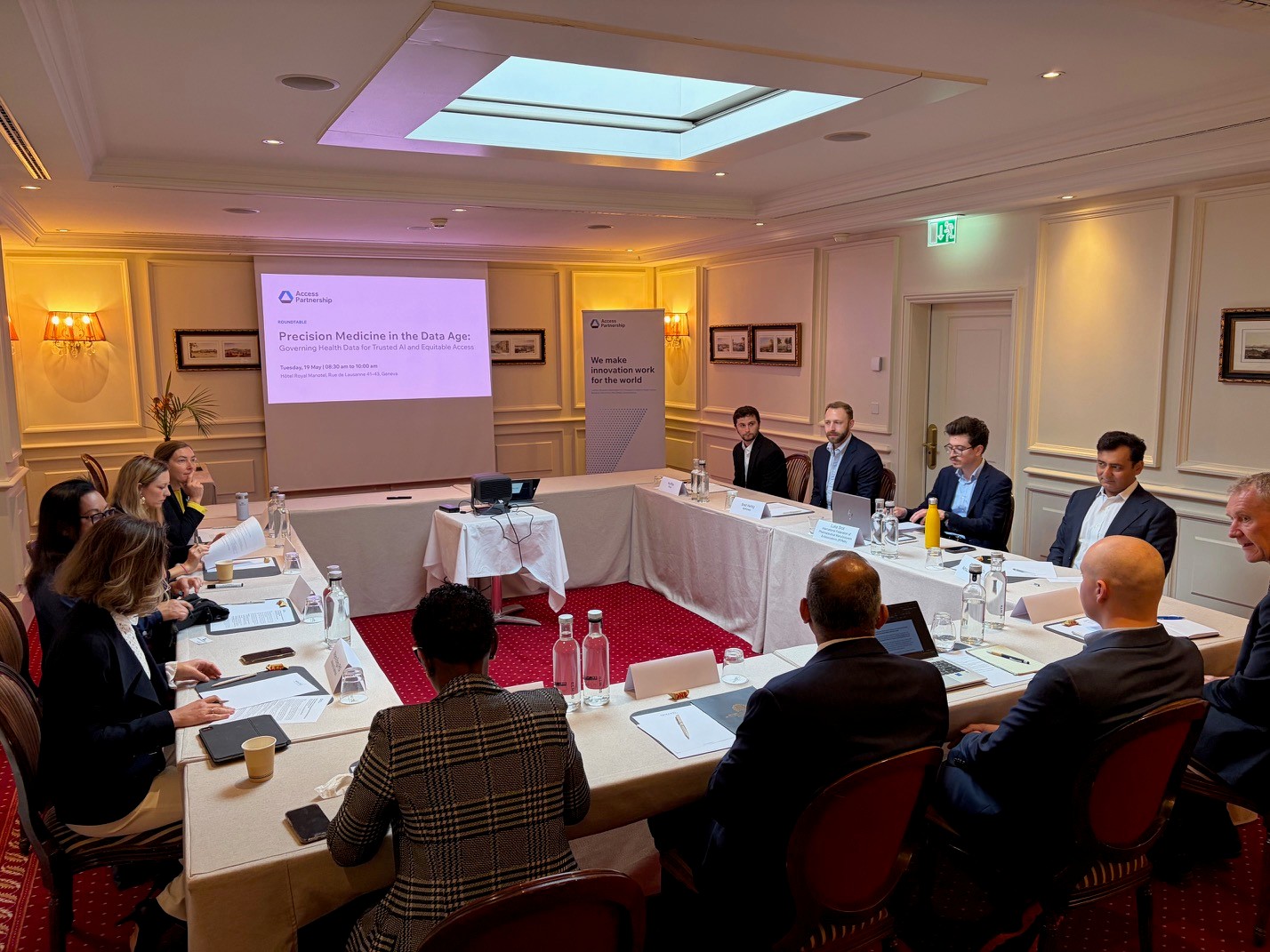
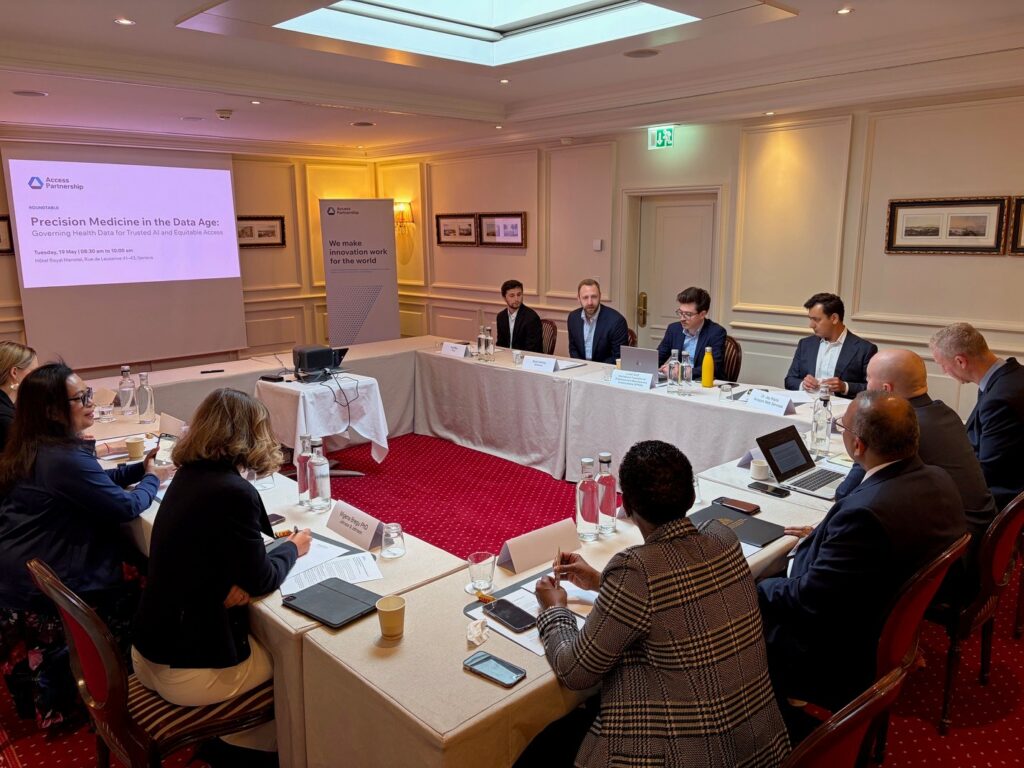
On the margins of the 79th World Health Assembly in Geneva, Access Partnership convened a closed-door roundtable on Precision Medicine in the Data Age: Governing Health Data for Trusted AI and Equitable Access. The discussion brought together a health minister, WHO leadership, regional institutions, pharmaceutical companies, cloud and AI providers, clinicians, think tanks, and policy experts. The timing was significant: Member States are weighing a landmark WHA resolution on precision medicine, and cross-border data governance is rising up the agenda ahead of the UN General Assembly later this year.
The science is advancing faster than the institutional architecture needed to govern it. Participants returned repeatedly to three interconnected gaps: trust, interoperability, and implementation capacity. The next phase will depend less on technical possibility than on whether governments, industry, and multilaterals can build governance models that protect rights, enable responsible data use, and avoid deepening global inequities.
Of the ten takeaways, trust is the most important. Patients have reason to be wary at multiple layers: their local provider, national authorities, the AI vendors, and the hyperscalers where data ultimately lives. The durable long-term answer is to bring AI as close to the individual as possible, with device-level AI on phones the likely endpoint. In the meantime, the only ethically viable AI offering is one that can promise three things: data used for AI processing stays local, confidential information is scrubbed at the end, and only the resulting analysis, alongside the original source data, ever resides somewhere as secure as the source was to begin with. If those promises cannot be made, AI should not be offered in clinical settings.
The equity gap compounds the problem. Genomic datasets and AI training models remain disproportionately drawn from populations of European ancestry, producing measurable disparities in areas such as cardiovascular and breast cancer risk prediction for African, South Asian, Indigenous, and other underrepresented populations. Across parts of the Global South, that science gap meets a broader trust deficit rooted in extractive data-sharing, limited benefit sharing, and weak local accountability. Without credible governance, adoption will stall regardless of technological progress.
A recurring tension: enabling international collaboration while protecting national, and ultimately individual, control over health and genomic data. Participants from emerging markets framed sovereignty not as a regulatory inconvenience but as a strategic and developmental priority. From a patient’s perspective, the only acceptable answer is that their data sits in the smallest possible concentric circle around them: their own provider, or at most a small local consortium. International collaboration belongs at the policy and aggregate level, not the data level. Two red lines follow. No access for organisations whose business model is data monetisation. No sharing of citizen-sovereign data with foreign organisations, however good the stated reason. For cross-border research, only anonymised data should be on the table.
Approaches are diverging sharply, with some governments pursuing strict localisation and others favouring more open frameworks. Countries don’t need to choose between sovereignty and interoperability, but they do need governance models that can support both.
There was clear alignment on the maturity of tools that support secure cross-border collaboration without sensitive data moving freely across borders. Federated learning, trusted research environments, privacy-preserving analytics, and synthetic data generation are increasingly viable and moving from theory into deployment. But governance models cannot simply be exported from high-income markets. Effective implementation will require co-design with LMICs so that technical architectures, legal safeguards, and accountability mechanisms reflect local realities.
Convergence is emerging around frameworks such as HL7 and FHIR, but regional systems are developing in parallel: the European Health Data Space, TEFCA, the Pan American Information Highway, and digital health initiatives across Asia. The strategic question is whether they will ultimately interoperate or settle into disconnected ecosystems.
This is also the takeaway where the ground is shifting fastest. Today’s AI models can already read unstructured data, including formats they were not designed to expect. Over time, the historic emphasis on rigidly structuring data to meet brittle standards will matter less. That doesn’t eliminate the need for standards, but it changes what “good enough” looks like.
Fragmentation persists inside national systems too, producing duplicated testing, delayed diagnosis, rising costs, and growing cybersecurity exposure. Recent ransomware incidents made clear that digital resilience belongs inside the interoperability agenda, not alongside it.
Precision medicine cannot scale without robust digital public infrastructure: digital identity, electronic health records, secure data exchange, and clear governance frameworks. That remains true even where data legitimately stays local: public infrastructure is what makes it manageable, secure, and usable inside the smaller concentric circles where it belongs.
The assumption that advanced systems will emerge first in high-income markets was challenged. India’s digital health identity infrastructure shows how emerging economies can build integrated systems more rapidly by avoiding legacy constraints. AI-enabled tuberculosis screening and diabetic retinal imaging across parts of sub-Saharan Africa point to leapfrog adoption already underway. Where workforce shortages and infrastructure constraints are acute, incentives to adopt AI-enabled clinical tools may be stronger rather than weaker.
Many health systems still operate through disconnected, disease-specific surveillance, screening, and registry infrastructures that limit early diagnosis and constrain population-level insight. Advances in AI, data processing, and digital infrastructure are, for the first time, making integrated precision public health technically feasible at scale. The Nordic registry model was referenced as a proof point. Replicating it elsewhere will require governments to treat registries and health information systems as long-term strategic infrastructure, not isolated research initiatives.
Guyana’s evolving approach was highlighted as an example of how smaller and emerging markets are adapting international regulatory models locally, drawing on European data protection frameworks to support electronic health record rollout and a regional life sciences and genomic research capability. Across regions such as the Caribbean, health data legislation remains uneven. Regional coordination mechanisms, including potential model legislation through CARICOM and existing PAHO mandates on digital transformation and AI in public health, offer practical pathways toward interoperable environments. The challenge now is translating political alignment into operational implementation.
Clinicians emphasised that AI is already integrated into healthcare delivery for diagnostics, workflow support, documentation, and decision augmentation, with tangible efficiency and access gains. The central concern is not whether AI should be used, but how to ensure it augments rather than substitutes human judgement. Overreliance on automated outputs, particularly among less experienced practitioners, could create new clinical risks if governance and training do not evolve in parallel.
Patient agency is the harder, less-discussed problem. When a patient learns an AI is doing something with their data, the first question isn’t whether the AI is accurate. It’s whose AI is it? My doctor’s? My doctor’s organisation’s? Something further upstream? Patients need a clear answer, and clear evidence of agency: that they can see what data the AI has touched, clear it out if they choose, and exercise meaningful control. Those mechanisms don’t really exist today in any consumer-facing form, and they will be hard to solve, but they are non-negotiable for sustained adoption. Transparency, explainability, fairness, accountability, and consent must be designed in from the outset, with patients, civil society, and frontline practitioners involved before deployment, not after.
Even where governance and infrastructure exist, many systems remain operationally underprepared to integrate genomics and AI into routine clinical practice. Modernising medical and public health education to incorporate genomics, data science, bioethics, and AI governance was a consistent theme, alongside investment in laboratory infrastructure, bioinformatics, and regulatory expertise, particularly across LMICs.
A quieter point also surfaced. Given the right tools, the existing workforce will be eager to adopt these capabilities, but only if two things are explicit from the outset. First, the AI is augmenting clinical judgement, not replacing it. Second, this isn’t big brother looking over their shoulder: clinicians cannot be left worrying that an AI will later flag something they missed and turn it into a liability or disciplinary issue. Rollouts that don’t address those two fears head-on will hit resistance, even with the best tools.
Industry highlighted capabilities essential to scaling AI-enabled precision medicine, including federated data architectures, open-access genomic repositories, accessible analytics platforms, and workforce upskilling. Governments and multilaterals cannot do this alone.
But “whole-of-society” cannot stop at industry. The Gates Foundation, Wellcome Trust, Rockefeller Foundation, and Chan Zuckerberg Initiative are not peripheral to this agenda. They are already funding and operating the health data infrastructure precision medicine will depend on in developing countries: genomic surveillance across sub-Saharan Africa, digital health identity systems in India and Kenya, primary funding of the Global Alliance for Genomics and Health. In many countries, a Gates-funded community health programme holds more comprehensive longitudinal data on rural populations than the national health ministry does. These foundations should be named as implementation partners, not donors to be solicited, with formal roles in WHA-level precision medicine governance, LMIC capacity-building co-design, and data-sharing frameworks that recognise foundation-held datasets as legitimate global research infrastructure.

Three priorities framed the close: advancing interoperable standards for health data governance and AI assurance; supporting implementation of the WHA resolution on precision medicine; and expanding investment in institutional and technical capacity across LMICs. WHO representatives reiterated their intention to keep convening stakeholders through existing partnerships with ITU, UNESCO, WIPO, the OECD, the World Bank, and the Global Alliance for Genomics and Health.
The policy debate has matured. What it now needs is not more consensus on principles, but a clear-eyed reckoning with the cost of delay. If the window closes, datasets will fragment along geopolitical lines, proprietary platforms will entrench extractive relationships with LMICs, and the genomic diversity problem will become structurally harder to solve. The next iteration should land on something concrete: a named multi-stakeholder commitment, a defined timeline, and an accountability mechanism the WHA precision medicine resolution can credibly hand off to. To support that, we intend to widen the next roundtable to include a device manufacturer, an NPO, and a HealthIT practitioner, rounding out the technical, frontline, and patient-facing perspectives the conversation now needs.






Our dedicated experts, located around the world, are here to help.