

Contact us
Need a problem solved?
Our dedicated experts, located around the world, are here to help.
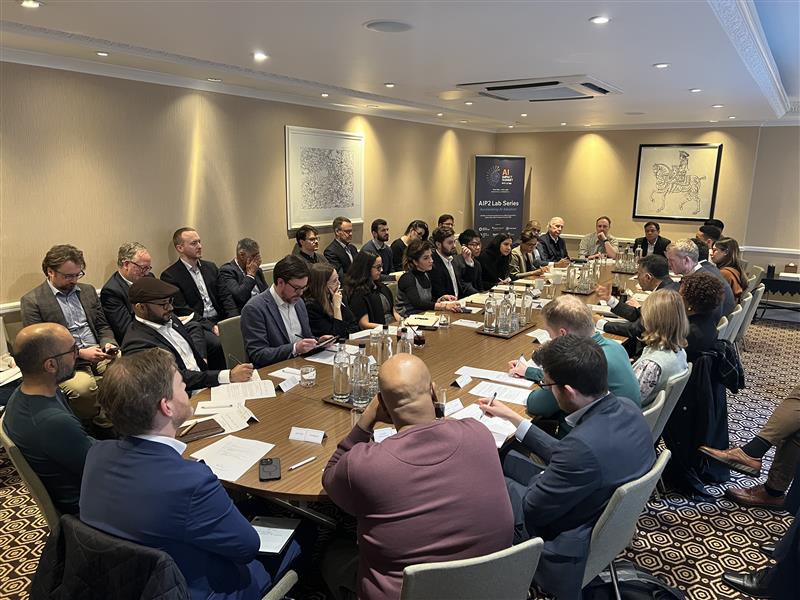
On 22 January 2026, Access Partnership convened the second AI Policy to Practice (AIP2) Lab in London, bringing together senior voices from government, industry, and the policy community to explore the next phase of democratic AI governance: moving from principles to real-world diffusion and impact.
A clear message emerged: the India AI Impact Summit should be anchored in what will be required to scale AI responsibly. Participants stressed that success will be defined by whether AI improves outcomes across sectors and geographies, and whether governance helps close (rather than widen) disparities in the capacity to build, deploy, and benefit from AI. Many noted that diffusion risks stalling AI when solutions aren’t tailored to local context, language, or sector realities – reinforcing the case for use-case-led governance.
A recurring tension came from the balance between digital sovereignty and openness, especially around data. Participants argued that sovereignty is often invoked without being clearly defined, and cautioned against treating it as a synonym for digital isolation. Instead, the discussion pointed to the value of “managed borders” that preserve privacy and security norms while enabling interoperability. Highlighting the practical economic benefits when data can move more easily across trusted pathways.
Participants distinguished between AI regulation and AI governance. Regulation matters, but governance also includes the day-to-day mechanisms that build trust and make adoption possible. Including assurance practices, organisational controls, accountability arrangements, and collaborative processes. Trust, in this framing, is not announced – it is built through open and honest dialogue, and through more participatory approaches that include practitioners early. Such as through sandbox-like environments where governments and deployers can learn what works.
The roundtable challenged the tendency to talk about AI as if it is monolithic. Participants highlighted the “revolution of the mundane” in enterprise AI. B2B deployments that generate real productivity gains but receive less public attention than consumer-facing tools. At the same time, governance becomes more complex when moving from B2B (Business-to-business) to B2G (Business-to-government) settings, where public accountability, procurement constraints, and citizen trust requirements change the risk calculus and the evidence needed to deploy at scale.
Security surfaced as a dual dynamic: a source of division by driving protective instincts and fragmentation, but also a potential force for cooperation. Participants noted that AI is reshaping cybersecurity for both defenders and attackers and suggested that shared security use cases could become practical entry points for alignment and new alliances.
The AIP2 Lab series continues in Brussels, shifting the focus toward people, skills and organisational readiness – an area participants flagged as essential, including the need to bring in younger technical voices closer to the front line of innovation.



Our dedicated experts, located around the world, are here to help.