Contact us
Need a problem solved?
Our dedicated experts, located around the world, are here to help.
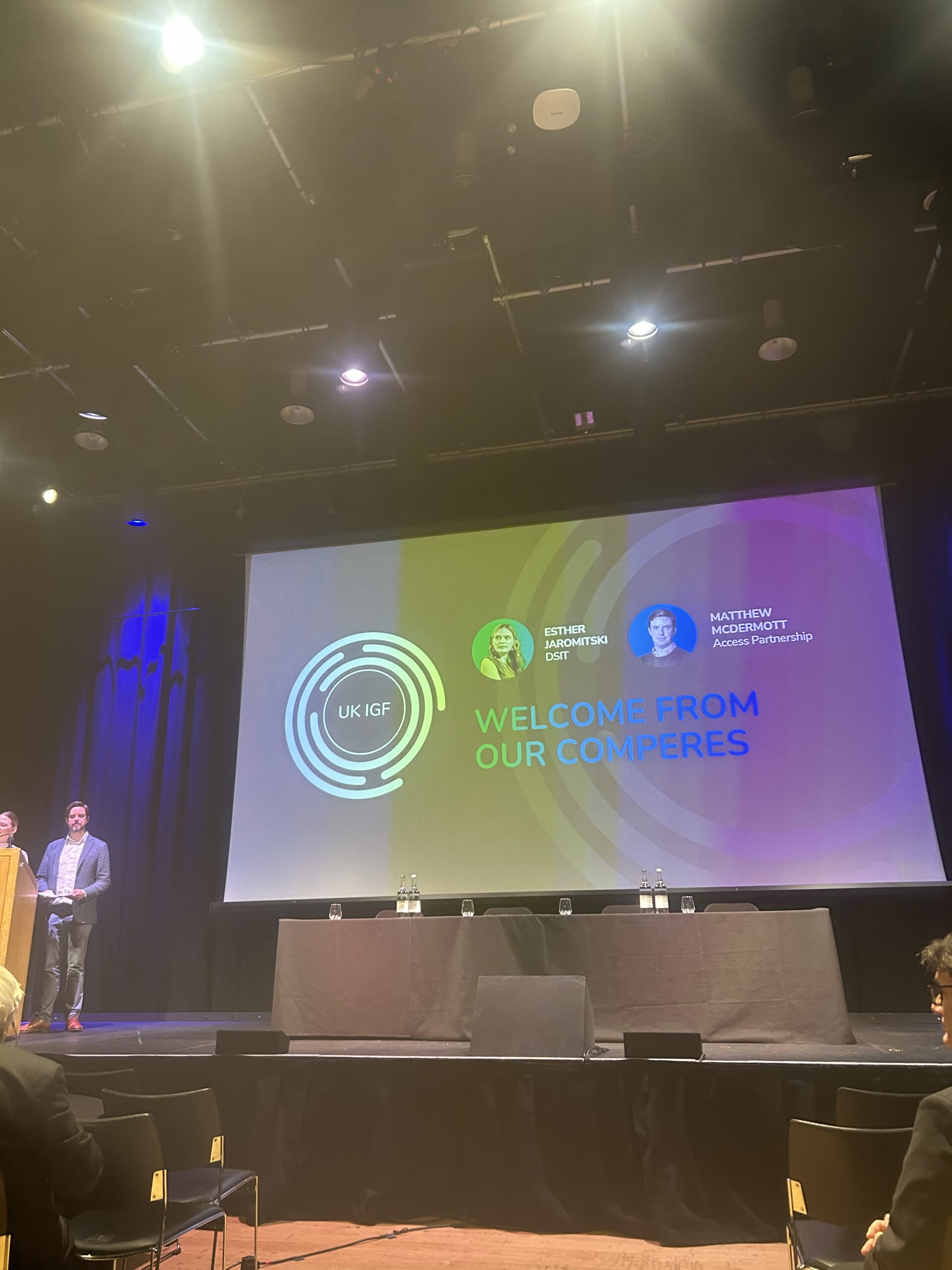
Six months after its 20th global edition, which was held in Norway, the UK Internet Governance Forum (IGF) reconvened in London last week, bringing UK stakeholders from government, industry, academia, civil society, and technical communities together for open dialogue and debate on how best to navigate fragmentation, safety, and the future of AI on the Internet.
Matthew McDermott, Director at Access Partnership, played a key role in organising the event and chairing proceedings on the day, serving as a member of the Organising Committee and Master of Ceremonies. The event reaffirmed the UK IGF’s role as a catalyst for collaboration and a platform for shaping policy responses to the most pressing challenges in internet governance.
In her opening remarks, Baroness Lloyd reaffirmed the UK’s ambition to lead internationally in promoting a safe, open, responsible, and innovative internet, drawing attention to several government initiatives across online safety protections, cybersecurity, data centre oversight, supply chain resilience, and the development of digital standards. This set the tone for the day: the UK is a not just a participant in global governance, but a proactive voice driving responsible and inclusive digital policy.
Digital fragmentation today concerns technical divides as much as it does social and economic inequalities. While the internet appears borderless, access and experience vary widely by demographic factors, including age, gender, income, and infrastructure access. Speakers drew on recent regulatory actions – such as Australia’s selective platform bans and US debates over TikTok – to illustrate the limits of blunt interventions, as users often adapt in unexpected ways. Fragmentation also runs deeper socially: algorithms amplify harmful communities, and generational gaps in news consumption widen, shaping political discourse. Rather than relying on bans, experts advocate rights-based policies, stronger digital literacy, and a nuanced understanding of user behaviour. Gaming, often overlooked, emerged as a space for identity and empathy, offering opportunities for education and inclusion. Finally, academics were urged to play a more active role in guiding regulation towards societal needs rather than industry priorities.
The workshop on AI ethics highlighted how hard it is to govern technologies built on energy-intensive infrastructure, global supply chains, and opaque datasets. Participants debated what fairness, transparency, and accountability mean in practice – and for whom – highlighting that ethical norms are far from universal. Issues such as data-as-currency, copyright disputes, and public unease about embodied AI such as robotics added further complexity. At the heart of these debates lay the critical question: who owns the data, how is it sourced, and can individuals opt out or monetise their contributions? Without clearer answers, ethical AI will remain an aspiration rather than a reality.
A lightning talk drew attention to how tech giants are increasingly at the frontier of AI research while simultaneously playing a critical geopolitical role through global strategic partnerships. Before our eyes, power in the digital economy is concentrating in a small number of firms that dominate cloud infrastructure, AI development, and start-up ecosystems – often through “double-dip” investments that secure privileged access and influence across the tech value chain. Public cloud has become the backbone of AI, storing data and enabling model training, and was described by Dr Cecilia Rikap as the “Tesco of digital technologies”. This growing dependency raises profound questions about sovereignty, democracy, and governance, as governments seek growth while grappling with ecological costs and largely unregulated resource demands. With AI requiring ever more energy, water, and data, progress cannot rest on technology alone; it also depends on political commitments to transparency, accountability, and equitable access.
On 16-17 December, the UN General Assembly will decide the future of the World Summit on the Information Society (WSIS), a two-decade initiative on digital cooperation with multistakeholder participation at its core. Debates in New York are unfolding against an increasingly polarised geopolitical backdrop. While there is broad agreement on the need to tackle the digital divide, strengthen capacity building, and improve how progress is monitored, there is far less consensus on the mechanisms to turn these commitments into substantive action. Themes of gender equality, diversity, and the UN Sustainable Development Goals (SDGs) have become the object of controversy. The G77 bloc – beyond its focus on development issues concerning connectivity, technology transfer, and AI governance – has become increasingly vocal about the concentration of decision-making power in the Global North, pointing to enduring imbalances in who sets the rules for the digital future.
The inaugural UK IGF took place in 2009 and given ongoing informal discussions about the possible role of new regional and national IGFs, the UK initiative could prove a valuable template for establishing these fora in the months ahead.
Whilst the UK Government recently announced its intention to introduce digital ID cards, the panel swiftly pivoted away from the idea of physical cards to the requirements of a broader digital ID infrastructure – one aimed at reducing fraud and simplifying everyday transactions. Drawing on examples from Latin American policymaking and use cases in refugee camps across the globe, the debate examined who controls identity and the risks of holding a nation’s biometric data in a central vault. Once data has been collected and systems built, their uses are difficult to contain.
Citizens require a system that prioritises outliers, lest they find themselves further marginalised, and safeguards individual rights. Ultimately, the discussion revealed a tension between convenience, security, and power: any credential worth protecting will be the target of hackers, and there is a delicate relationship that must be maintained between the state, citizens, and any private intermediaries to build trust from the bottom up.
The final session of the day underlined that keeping children safe online is insufficient; we must also protect their freedom of privacy, expression, and other fundamental rights. Despite making up one-third of internet users, children remain largely invisible in global processes like WSIS and are often treated through an adult-centric lens. Panellists highlighted gaps in current approaches, from poorly designed parental controls and normalised biometric data collection in schools to policy responses that exclude children from digital spaces rather than addressing systemic risks. They called for child rights impact assessments, meaningful consultation with children, and transparency from companies, noting that bans and blunt interventions can create unintended harms, such as grooming opportunities. The discussion urged a reimagining of safe digital environments that balance protection with participation, ensuring children’s voices shape innovation and regulation.
The UK IGF reaffirmed its role as a vital platform for shaping inclusive and forward-looking internet governance, tackling issues from fragmentation and AI ethics to digital identity and children’s rights. As global debates intensify ahead of the WSIS+20 review and other multistakeholder processes, continued engagement is essential. If you would like more information about the UK IGF, WSIS developments, or access support in navigating debates on global internet governance, please contact Cerys Stansfield at [email protected].





Our dedicated experts, located around the world, are here to help.