Contact us
Need a problem solved?
Our dedicated experts, located around the world, are here to help.
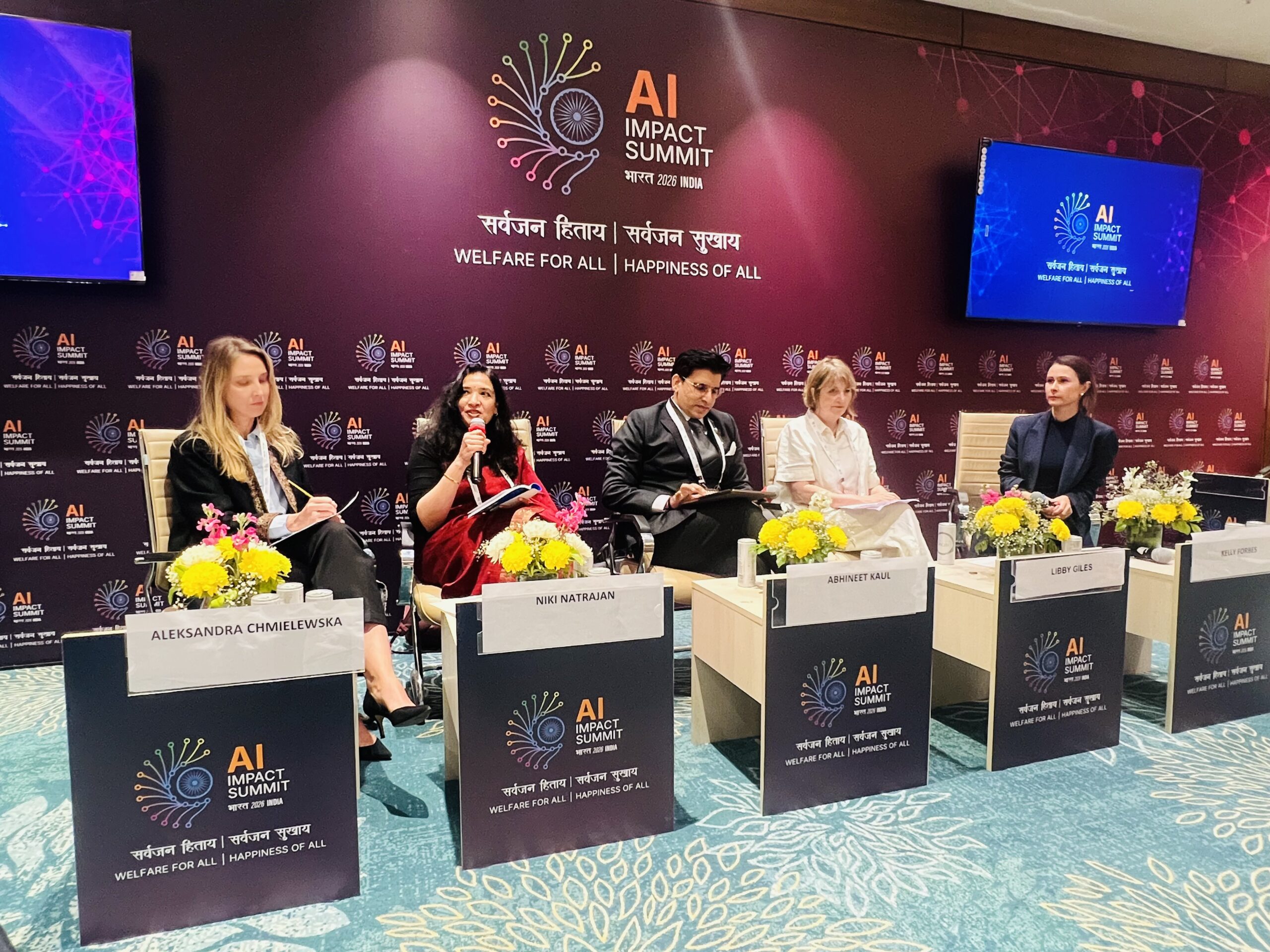
The India AI Impact Summit marked an inflection point. It wasn’t just another large AI gathering; it reflected a broader structural shift in how countries are approaching artificial intelligence (AI).
AI governance has moved beyond drafting principles to building systems. And that shift was visible in New Delhi.
India’s framing, centred on impact, inclusion, and deployment, signals an evolution from hypothetical discussions of risk and ethics towards a more grounded question: How do countries operationalise AI at scale while preserving trust, sovereignty, and economic competitiveness?
At Access Partnership, our contribution to the Summit focused precisely on the transition from narrative ambition to governance architecture.
For years, global AI conversations have revolved around ethics frameworks, voluntary codes, and high-level declarations. These are necessary foundations, but no longer sufficient in isolation. The Summit made clear that the next frontier is diffusion: embedding AI into public services, financial systems, MSMEs, education, and healthcare in measurable ways.
This requires three structural capabilities:
Access Partnership’s engagements at the Summit, including the release of our The Global South AI Diffusion Playbook, were designed to support precisely these pillars. This aligns with our work with governments and the private sector: governance must be executable, not aspirational.
A recurring theme throughout the Summit was sovereignty and the practical examples of how sovereignty accelerates AI diffusion. However, sovereignty in AI cannot be reduced to localisation or isolation. The emerging question was more nuanced: How can countries build sovereign capacity while remaining interoperable within global AI systems?
At Access Partnership, we have argued consistently for modular governance models that:
The Summit underscored that the future of AI governance will not be a binary choice between globalism and nationalism. Instead, it will depend on carefully engineered bridges between domestic policy objectives and global standards. Countries that design these bridges effectively will shape the rules of AI’s economic integration.
Another insight from the Summit is that AI ambition must be tied to measurable public value. To move from experimentation to economic transformation, governments must embed evaluation mechanisms into their AI strategies:
AVPN’s AI for All Workforce Skilling Policy Toolkit, developed in collaboration with Access Partnership and launched at the Summit, focused on precisely the challenge of building practical metrics for AI diffusion that align with socio-economic objectives. Without measurement, AI policy risks becoming symbolic. With measurement, it becomes accountable.
The Summit demonstrated India’s convening power by bringing together governments, industry, academia, and civil society. This model reflects an emerging reality that AI governance is too complex for single-actor regulation.
Effective deployment requires:
Access Partnership’s AI Policy-to-Practice Labs, conducted in Washington, DC, London, and Brussels, informed our Summit engagements. They were built to ensure that governance must be co-designed by those who implement and those who regulate. This is not just inclusive governance. It is resilient governance.
The most significant takeaway is that AI leadership is no longer monopolised by a small group of frontier economies. Countries across the Global South are now shaping how AI will be adopted at scale, particularly in public service delivery and digital public infrastructure.
This presents a structural opportunity. Rather than replicating legacy industrial models, countries can leapfrog by integrating AI into digital identity systems, financial inclusion platforms, agricultural advisory services, and healthcare delivery networks.
But leapfrogging requires governance models that are pragmatic, adaptable, and economically aligned. The Summit highlighted growing momentum around this approach.
If the past phase of AI governance was about articulating principles, the next phase will be about engineering systems.
The India AI Impact Summit reflected this shift. The real test, however, lies ahead:
At Access Partnership, we view this moment as a turning point where ambition must crystallise into architecture. Our work following the Summit will focus on supporting governments and industry partners in building:
AI’s future will not be decided by declarations alone. It will be shaped by those who can convert strategic intent into operational systems.
The shift has begun. Now comes the engineering.




Our dedicated experts, located around the world, are here to help.