Contact us
Need a problem solved?
Our dedicated experts, located around the world, are here to help.
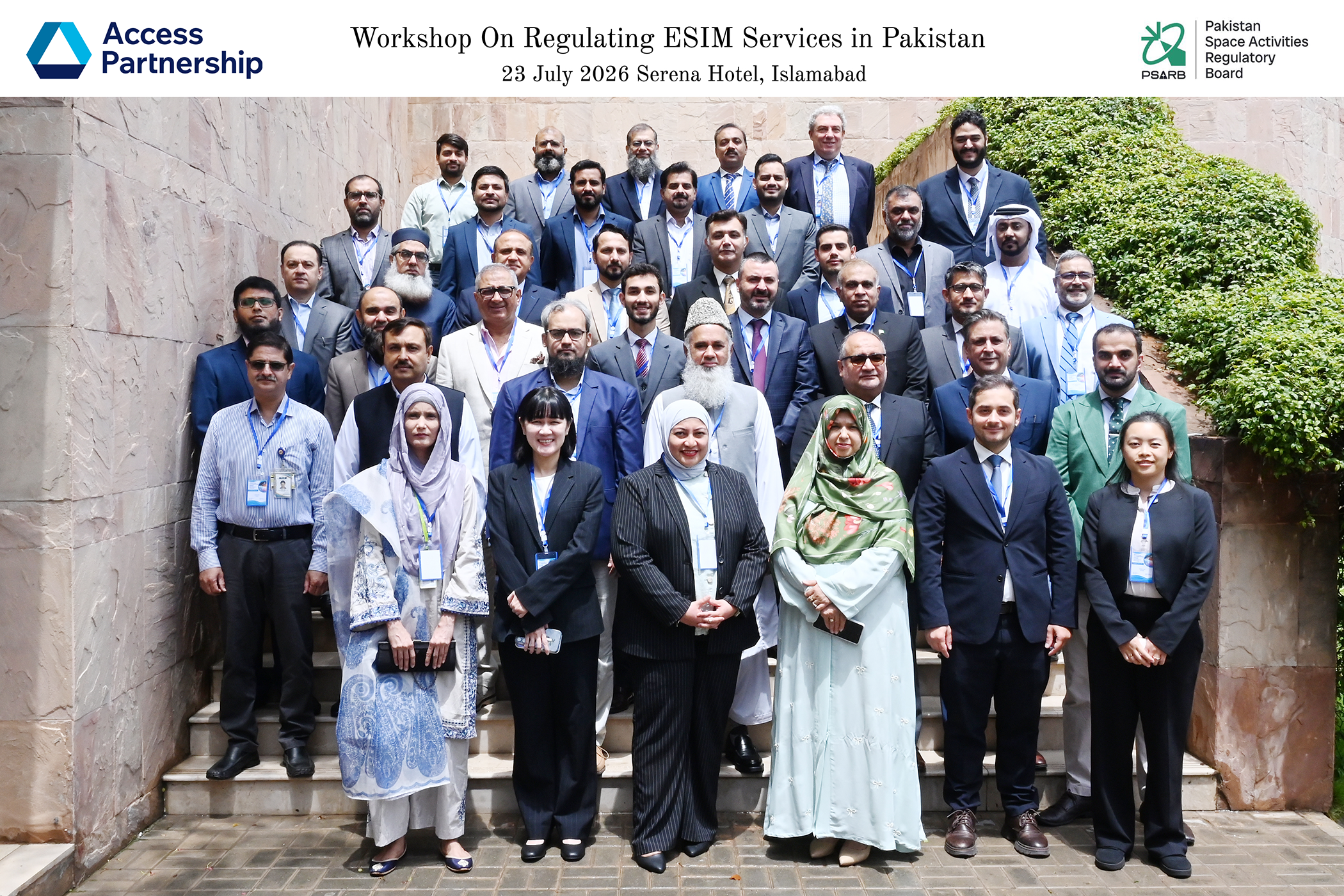
Last week in Islamabad, Pakistani regulators and the international satellite industry met to work through one of the more complicated questions in space policy: how to authorise Earth Stations in Motion, or ESIMs, the satellite terminals that keep aircraft, vessels and vehicles connected while on the move.
The workshop was convened by the Pakistan Space Activities Regulatory Board (PSARB) and Access Partnership, bringing together operators including SpaceX, Amazon Leo, Gogo, Turksat, Space42, Kacific, Viasat and Eutelsat with Pakistani authorities spanning defence, telecommunications, aviation and maritime affairs, among them the Pakistan Telecommunications Authority (PTA), the Frequency Allocation Board (FAB), the Civil Aviation Authority (PCAA) and the Space and Upper Atmosphere Research Commission (SUPARCO).
An ESIM licence touches several different parts of government at once: satellite landing rights, telecoms licensing, spectrum management, equipment approval, aviation and maritime safety, and national security. Looking at regulatory best practice in other jurisdictions, the clearest lesson is that coordination between authorities matters more than the underlying technology. Countries that get this right tend to treat ESIM approval as one process with several owners, rather than several separate approvals that happen to run in parallel.
That is the problem the workshop was designed to address. Sessions worked through how the framework would apply to foreign-registered aircraft and vessels: overflight, arrival and departure, port calls, landing rights, terminal authorisation, type approval and interference protection, and, underneath all of it, which authority is responsible for what.
Recently, PTA has been developing a proposed No Objection Certificate (NOC) process alongside an In-Flight Telecommunications Service (ITS) licence, aimed at A-ESIMs in Pakistani territory – the workshop gave an opportunity to the regulatory system to test that pathway against the operators who would actually use it, and against each other.
Space is ultimately a tool for development, and ESIM services are a clear example of how space technology can deliver practical benefits through better connectivity for aircraft, vessels, and people on the move. The time has come to open Pakistan to these services through a clear, enabling and internationally aligned regulatory framework.
Pakistan is at an important point in the development of its satellite communications market. This workshop convened the relevant authorities and industry to understand how ESIM services operate in practice and to consider a regulatory pathway that is secure, proportionate and workable.
PSARB and Access Partnership will use the workshop’s outcomes to continue supporting the development of Pakistan’s ESIM framework, along with the coordination mechanisms the different authorities will need once it is in force. There is more work ahead before the framework is finalised, but the direction is now clearer than it was before the workshop: towards a regulatory system that international operators can actually plan around, and that gives Pakistan a functioning route to into the ESIM market.




Our dedicated experts, located around the world, are here to help.